Monday, June 8, 2009

Miike Double Feature: Detective Story (2007) and God's Puzzle (2008)

Hayato Ichihara and Mitsuki Tanimura in Takashi Miike's God's Puzzle (2008).

Two films by Takashi Miike that has recently been released with english subtitles that both feel like something he could have made ten years ago. Personally, I don't feel that Miike's new direction that fans sometimes complain about is all that different from what he used to do, he just has more money to do it now but that doesn't stop him from churning out a few v-cinema flicks now and then. It's also easy to see the connections between films like Crows Zero (2007) and Crows Zero II (2009) and earlier works like the two Young Thugs (1997-1998) films and The Way To Fight (1996) and the line of existential questions going through Izo (2004), Big Bang Love, Juvenile A (2006) and God's Puzzle (2008), although Izo is probably the film that started what some would call Miike's decline.

Miike has always been all over the map when it comes to genres, he's been doing dramas, comedies and just about every variation of a yakuza film imaginable, the genre he's probably most famous for among casual fans, horror, is one where he has worked the least, so seeing him make more family oriented films shouldn't come as a huge surprise. And at the same time as he's been making films like Zebraman (2004), The Great Yokai War (2005) and Yatterman (2009) he's made Waru (2006), Sun Scarred (2006), Like A Dragon (2007) and Sukiyaki Western Django (2007) among others. I feel as if Miike is just moving forward by expanding his line of work while at the same time he keeps in touch with his roots.

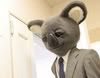
Strange looking characters in Miike's Detective Story (2007).

Detective Story is a straight-to-video (apparantely it did play a few theaters) gory horror/crime comedy about a former policeman now working as a detective, Raita Kazama, played by Kazuya Nakayama, who gets involved in the case of a woman being murdered the same night as she has visited his home to ask for his help. Naturally, the detetive becomes the suspect. To make matters worse different possessions of his starts to pop up at the murder sites as more bodies start piling up. The only other connection between between the victims is their interest in a mysterious artist named Yuki Aoyama who paints in blood and ground up meat. To his help, the detective has his two assistants and a newly moved in neighbor who shares his first name and who's a computer wiz who is reluctantly drawn into helping Raita No. 1 with the case.

The film turns into a bizarre crime mystery, mostly because of the mix of gore and weird sense of humor and the overacting by Nakayama in the lead. There just doesn't seem to be any other reason for his weird behaviour other than that he's a just a big kid inside who refuses to realize that he's grown up, which might explain his clothes. This is nothing new though for a Miike film produced by Hisao Maki, the man behind the Bodyguard Kiba (1994-1995) films, Silver (1999), Family (2001). As a product of a Miike-Maki collaboration, Detective Story still fares pretty well. Even though it's a bit too silly to be taken seriously as a crimethriller it is still fairly entertaining and Nakayama's odd performance is fun to watch. At least Maki settled for a tiny cameo as a police chief in this one instead of playing the hero's martial arts mentor and having a meaningless fight scene spliced into the middle of the film. It's hard to imagine that Maki also produced Miike's contemplative homoerotic prison drama Big Bang Love, Juvenile A.

Ryuhei Matsuda and Masanobu Ando in Big Bang Love, Juvenile A (2006).

God's Puzzle is a bigger film than Detective Story, produced by Haruki Kadokawa. The premise isn't really that complicated, Kiichi is about to graduate from university but decides to go on vacation, sending his delinquent twin brother, Motokazu, to physics class in his place since all he needs to graduate is the attendance and since all Motokazu has to do is sit there, it won't be a problem that he doesn't know the first thing about physics. Things get complicated when he actually shows up in class and a teacher asks him to encourage another student to come to class, isolated girl genius Saraka. She agrees on the condition that Motokazu helps her with a science project, to figure out what the nothingness that our universe was created out of consisted of and to try to create a new universe.

Now the english subtitles on the Malaysian dvd are pretty bad, so this is where things get shakey. The first half of the film is mostly physics talk about particles, energies and theories about how the universe was created and what would happen if man was actually able to create a universe. Would it create a black hole that would swallow our own universe? If man were able to create such things, would there be any need for a god and would scientifically proving that everything that is needed to create a universe and what is contained in the nothingness out of which our universe was born is right under our noses also prove that there is no god? But God's Puzzle also deals with the troubles of youth, growing up and finding out who you are and dealing with the unwanted expectations of others, things that are close to heart of Saraka who was concieved as a "manmade" test tube baby.

Although I enjoyed just about every minute of God's Puzzle, there are some weaknesses. Hayato Ichihara's Riki Takeuchi like mugging and screaming of every line does get a bit annoying sometimes and at 133 minutes it feels a bit overlong, with the disaster movie ending actually feeling more drawn out than the first part of the film, but it's all saved in one of the greatest moments in Miike film history. In spirit, acting and setting it was reminiscent of his early Osaka films but with a sci-fi twist.


While Detective Story shows that Miike, despite making big budget blockbusters now, is still not above getting knee-deep in blood and guts and v-cinema filmmaking, God's Puzzle proves that he also, while making bigger films, can bring together all the energies that made some of his early work so great.

Saturday, June 6, 2009

Malaysian Gods (Amir Muhammad, 2009)

Poster for Amir Muhammad's 2009 documentary Malaysian Gods.

In 1998 the deputy prime minister of Malaysia, Anwar Ibrahim, was arrested and later sentenced for corruption and sodomy. This caused widespread anti-government protests and Anwar was seen as a prisoner of conscience by Amnesty International.

Amir Muhammad's documentary, Malaysian Gods, recaps the events of 1998 by using text screens and by visiting the sites where the protests took place, interviewing random people there about how their lives have changed since the protests and what they think have changed in society. All of the interviews are in Tamil language, the Tamils constitute the major part of Malaysia's Indian minority that makes up for 8% of the population.

While things does seem to have changed, a lot of things remain the same. In 2007 protests against governmental policies favouring ethnic malays took place and the organisation behind them HINDRAF (Hindu Rights Action Force) was declared illegal in 2008. Also in 2008, Anwar Ibrahim, who after being released from prison in 2004 has become leader of the political opposition in Malaysia, was once again brought in for questioning about charges of sodomy.

These events are shown in both a ciritcal and a humorous light and while it does feel like Malaysian Gods is only scratching the surface it keeps Malaysia from becoming just another exotic location in other films.

Wednesday, May 27, 2009

Ugetsu (Kenji Mizoguchi, 1953)

Machiko Kyo and Masayuki Mori in Kenji Mizoguchi's Ugetsu (1953).

When I watch a film I ususally try to know as little as possible about it beforehand to avoid spoilers to really get to experience it without any prior knowledge about plot twists and to let the film set its own mood. With Ugetsu, knowing no more than that it's a ghost story was still a bit too much and made some of it very predictable, but what I didn't expect was how much I was going to enjoy it. I will be writing some things about Ugetsu that I'm not really sure of, but one thing that I'm certain of is that Ugetsu is a truly masterful film and since it is the first film directed by Kenji Mizoguchi that I have seen I have a lot of catching up to do.

When I first watched Akira Kurosawa's Stray Dog (1949) I thought that it was mainly about the characters and their choices and not so much post war Japan's influence on them, even though, of course, it is there. I felt that the characters ultimately had their lives in their own hands, that it was their own decisions that decided their fate and society was never the cause for how someone turned out. But when reading a bunch of reviews online, they mostly talked about how Stray Dog was a reflection of the times it was made in than anything else. While watching Ugetsu I thought that this is probably more of an allegory for post-war society than anything I've seen so far by Kurosawa, but after finishing it and reading some reviews, everyone was just writing about the characters as individuals and their actions as reactions to the closed off, fictional film world they live in and nothing about the film as a mirror image of Japan at the time it was made. So I'm either reading in the wrong places or I don't know what I'm talking about and right know I'm leaning towards the latter since all my knowledge of Japan does come from watching Japanese films.

In Ugetsu, war is raging, and it has opened up economic possibilities for farmer and potter Genjuro and his friend Tobei to sell their goods at the market in a nearby town. After going there the first time and having made some easy money, Genjuro and Tobei, for different reasons, are prepared to risk anything and everything for more money. Genjuro to provide a better life for his wife and daughter and Tobei to become a samurai to impress his wife. One night while their village is being raided by soldiers all Genjuro can think of is keeping his pots safe so he can sell them the next day, even risking his life while doing so. The morning after, Genjuro and Tobei heads to the market with their wives in tow but after being warned about pirates Genjuro decides to leave his wife Miyagi and their child behind because of the dangers that might lie ahead. While at the market, Genjuro is invited by a Lady Wakasa to her mansion to deliver the goods she just purchased and while there Genjuro is flattered enough by her not to return to his family. At the same time, Tobei is finding fame as a samurai by taking credit for the killing of a general that he only witnessed but didn't perform.

Perhaps the actions of Genjuro and Tobei and the results they bring could be seen as a warning against blind obsession with economic growth, and that abandoning your family could translate into giving up on your old values in favor of quickly gained fortunes in a more modern Japan. Fortunes that can turn out to be nothing but illusions that come with a higher price than expected. Ugetsu does seem like a conservative film with the point being to know your place, remain in the old and for women to stay at home at take care of children but while watching it, it felt more like a cautionary tale, not telling you to stay put, but to not rush headless into something just because you feel flattered by it or a promise of easy money.

Sunday, May 10, 2009

Robo Rock (Taikan Suga, 2007)

Taikan Suga's Robo Rock (2007).

In a way, I think Robo Rock (2007) was just what I needed. I've been watching a lot of films lately, but I think being too focused on work has left me kind of numb to them and stopped me from really enjoying them. Watching Crazed Fruit (1956), directed by Ko Nakahira, just made me think that despite the film's history, it just wasn't very interesting to see a bunch of spoiled, disaffected brats try to deal with every day emotions. Mikio Naruse's When a Woman Ascends the Stairs (1960) left me as feeling as distant to the film as Hideko Takamine's character wanted to be to her clients, even though I did like the film. Seijun Suzuki's The Flowers and the Angry Waves (1964) almost bored me to death and it took me a whole lot of tries to get through it. I also watched a few pink films, Bitter Sweet (Mitsuru Meike, 2004), Empty Room (Toshiki Sato, 2001) and Tokyo X Erotica (Takahisa Zeze, 2001) and they all left me cold, wishing Artsmagic wouldn't have stopped releasing the films of Hisayasu Sato and Kazuhiro Sano a few years ago.

So this is when I popped Robo Rock in my player, a low-budget comedy about a loser named Masaru (Shun Shioya) who works as a handy-man, which means he's doing all kinds of odd jobs given to him by a mediator, in Masaru's case Ibume (Kenichi Endo). The jobs may include everything from stealing panties off of clotheslines to delivering drugs to South Americans. The latter is what gets Masaru into trouble. At the same time, a nerd named Nirasawa (Yuichiro Nakayama) who is obsessed with big machinery and robots in particular, is convinced that Masaru is the only one capable of commanding a giant robot named Land Zeppelin to protect the earth against an impending Saturnian invasion.

This all sounds stupid enough, so mentioning Masaru's girlfriend Kiriko (Minami) who's a tattoo artist with only one design and the horrible western actors playing drug dealers might not be neccessary, but inside all this stupidity is a very entertaining film. It doesn't matter that it seems to be stealing bits and pieces from other films to create a whole, that the acting isn't always top notch, or that they seem to have spent the entire budget on special effects in the last 10 minutes of the film, since the result is more than the sum of its components. Robo Rock is great fun and it has a giant transforming robot.

Monday, April 13, 2009

Late Bloomer (Go Shibata, 2004)

Masakiyo Sumida as Sumida in Go Shibata's Late Bloomer (2004).

Late Bloomer is the story of Sumida, a disabled man who lives alone in a big house and whos only company is that of his two caregivers. Sumida spends most of his days driving around town on his electric scooter or drinking and going to concerts with his caregiver Take who is in a band.

Though not very able bodied due to his handicap and only being able to speak through a digital speaking device, his mind is as clear as day. He has all the same feelings and needs as everyone else but not in a simplified manner. When he's horny he watches porn, he likes to get drunk with Take and he loves women. This is not some sugar-coated story about a disabled person having to overcome a specific task, Sumida lives with the pain and frustration of understanding how he's different and not being able to express himself like everyone else, every second of each day.

When he develops a crush on a new helper, a college girl named Nobuko, things become more complicated as it turns out that Nobuko is just using Sumida for a paper she is writing. He's just like an object for her and her friends to study and exploit, and it pushes Sumida over the edge.

My first thought when I started watching Late Bloomer was to turn it off, through extreme close ups and weird angles and a style similar to that of Shinya Tsukamoto's Tetsuo - The Iron Man (1989) Sumida is made out to look like a monster. But as I hung in there I started to feel like the excessive way in which Sumida is portrayed made me question my own sense of being an unprejudiced person. Maybe it wasn't the way the filmmaker saw him, or how Nobuko and her friends saw him but also how I saw him when I started watching the film. To me it felt like the style helped in putting all of Sumida's needs and feelings of inequities against him right in the viewers face and not only make you know they were there, but to truly evaluate Sumida's complete situation and it makes it hard not to feel for him despite his actions later in the film.

Even if it's easy to see how the style might be off-putting to a lot of people, and that the film has some parts that feel superfluous even at only 83 minutes in length, Late Bloomer is a strong film that, at least, made me re-evaluate if I'm really as open-minded as I think I am.

Tuesday, March 31, 2009

Quick takes #3

Tae Kimura in Ryosuke Hashiguchi's All Around Us (2008).

All Around Us (Ryosuke Hashiguchi, 2008) - Ryosuke Hashiguchi returns to directing for the first time since 2001's Hush! with a drama about a married couple spanning over ten-something years, from the early 90's into the 00's. At first I was wondering where the film was going, what was the point of spending 140 minutes following this couple when the film didn't seem to go anywhere. There is no real story, no big conflict that needs to be resolved and I think that is one of the films strengths.

There are ups and downs, when their newborn child passes away, the wife goes into depression, but instead of some big eyeopening moment, it is worked out over time, years, through small things, things that makes it believable how their love grows stronger over the years despite their flaws. This along with the great acting from Lily Franky and Tae Kimura as the couple make the film and characters seem so much more real.

Once I got passed the lack of any real story and could just get into the film I noticed that I wanted to know what would happen next to this couple even if there was nothing happening at all.


Ong Bak 2 (Tony Jaa, 2008) - A simple story turned into a mess through an uninvolving, excrutiatingly boring first hour. I know, it's my own fault for expecting something as energy packed and cheap but entertaining as the first Ong Bak, but set in the 1400s instead of present day, but who didn't? Tony Jaa wanted more though, but maybe directing, writing, choreographing the fights and starring was too much for his directorial debut. Ong Bak 2 is basically a story about vengeance and what the right or wrong reasons behind violence can be and Jaa should be commended for his ambition, but in my opinion, he didn't pull it off.

The last half hour though is one great big fight scene with Jaa pulling together everything that his character learned earlier in the film and is the first time the film really comes to life, almost making the first 60 minutes worth sitting through, but then the ending is another let down. Due to all the troubles with the production, Jaa disappearing from the set for two months among others, they didn't have time to finish the film in time and the ending is used as a cliffhanger for part three which has been announced. I'm just not sure I want to see it if Jaa is still behind the camera.

Saturday, March 28, 2009

224466 (Tadanobu Asano, 2008)

Tadanobu Asano, Ayane Omori and Ryo Kase in 224466 (2008).

Short film written by Shinji Aoyama and directed by Tadanobu Asano as part of the R246 Story project. The dvd didn't have any subtitles and my understanding of Japanese is extremely limited but I think 224466 is more of a an audio/visual ride, and as far as I could tell Asano plays an alien who when he arrives on earth loses his source of power, a rainbow colored drum set. By chance he comes across a young girl who can knock people out with her awesome guitar playing and a ragged looking man who carries around her amp and they decide to try and find the drum set together.

I haven't seen Asano's directorial debut Tori (2004) but here it looks like he's ripping off earlier films he's starred in, most notably Electric Dragon 80.000V (2001), directed by Sogo Ishii. Scenes of Asano's alien walking the streets searching for his drum set and taking weird poses are reminiscent of Dragon Eye Morrison searching through the streets of Tokyo for runaway lizards and the look of the film is a bit Ishii/Tsukamotoish. It's still enough to make me want to see more from Asano the director though and most of the 25 minute running time is both interesting to look at and entertaining. I just wish the drum/guitar showdown at the end would have lasted longer.

Sunday, March 1, 2009

A Lonely Cow Weeps at Dawn (Daisuke Goto, 2003)

Horyu Nakamura and Ryoko Asagi in Daisuke Goto's A Lonely Cow Weeps at Dawn (2003).

New distributor Pink Eiga just released another couple of films, one of which is A Lonely Cow Weeps at Dawn, a rural drama about an aging farmer living with his daughter in law. The problem is that the farmer, Shukichi, is suffering from dementia and is slowly getting worse and worse, he doesn't realise that his favorite cow Hanako died a long time ago and that now it's Noriko, his daughter in law, that's waiting for him in the barn every morning. Noriko's husband, Shukichi's son, died a few years earlier and while Noriko has stayed on the farm she and Shukichi has come to have an unspoken love for each other. Things doesn't get easier when Shukichi's daughter comes back to town after ten years and teams up with a local scoundrel who is trying to get his hands on the deed to Shukichi's farm.

The story might make it sound like A Lonely Cow... is just another Japanese film going for the weird and crazy but director Daisuke Goto avoids making things too absurd by keeping the film low key and more focused on quiet emotions and strong acting rather than the sex scenes that pink films are known for. They are still there though.

A Lonely Cow Weeps at Dawn is, a story about getting old and a story of acceptance, not only of accepting that you will age and become weaker and possibly ill, but accepting that people are different, no matter how cliché that may sound. The scenes where Shukichi tries to milk Noriko, thinking she's his cow, made me think of when people get their whole lives cross-examined in the media, where every little deviation from what's considered normal behaviour, no matter the context, and it makes the viewers/readers judge those people without really knowing anything of what was behind their actions. Take certain parts out of anyone's life and I'm sure you could make it into something very weird. Perhaps it is a bit far fetched to take it that far, but ultimately, what happens between Noriko and Shukichi only happens because they accept each other and in the end themselves for who they are even though they know their love won't be accepted by society.

I hope Pink Eiga will keep it up with releasing these more serious pink films, so far they haven't disappointed.

Sunday, February 15, 2009

Quick takes #2

Supposed scarecrows in Kenta Fukasaku's X-Cross (2007).

X-Cross
(Kenta Fukasaku, 2007) - My expectations on a new film by Kenta Fukasaku were at rock bottom after the crap fests that were Battle Royale II (2003) and Yo-Yo Girl Cop (2006) but Fukasaku actually delivers some high-tension suspense with X-Cross, even though it's somewhat ruined by too much sucking up to fans of the crazier side of Japanese cinema.

The film starts out with Shiyori and Aiko going on a trip together to a secluded village resort following the break up between Shiyori and her boyfriend. They soon discover that the villagers are up to some foul play involving cutting limbs off of young girls and sacrificing them to their gods and as if that wasn't enough, there's an insane scissor-wielding woman in a french maid's uniform after Aiko.

The plot is just as silly as it sounds but Fukasaku manages to put the screws on and make you feel like there really is no escape when the villagers chase the two girls through the woods. The structure of the film, being told in flashbacks from Shiyori's and Aiko's perspective cross-cut with each other also helps to keep you guessing who's really to be trusted, but the tension is ultimately ruined by some strange choices, like having Aiko turn into a chainsaw-wielding, ass-kicking heroine and some ill-placed humor. A more serious approach would have been a better fit for the rest of the film.


I Just Didn't Do It (Masayuki Suo, 2006) - Masayuki Suo's return to the cinemas ten years after making Shall We Dansu? (1996). It deals with a man, Teppei, falsely accused of groping a teenage girl on a packed commuter train and when charged refuses to admit to it to get off easier since after all, he didn't do it. Suo depicts the Japanese legal system as a corrupt process, everything from the arrest and interrogation of Teppei up until the final verdict is more about just falling in line with the authorities and accepting the blame to get off with a slap on the wrist, no matter if you're guilty or not. But if you stand up for yourself thinking the truth will be known, the system will crush you.

I don't know enough about the legal system in Japan to go into all of the details that the film brings up during its 140 minute runtime but as a film it is very engaging and upsetting. You really get to feel for Teppei, played by Ryo Kase, and his fight to clear his name. But the main focus isn't really on his being guilty or not but on the actual process and the system that causes the fact that it's better to confess to something you didn't do and that you have to prove your innocence rather than that the prosecutors have to prove your guilt. Suo couldn't have made a better return.


Raw Summer (Keisuke Yoshida, 2006) - The directorial debut of Shinya Tsukamoto collaborator Keisuke Yoshida is another film on the theme of train gropers but here it is an actual stalker, Masuo, who is following a high school girl, Anko, around, taking pictures of her from a distance.

When Masuo works up the courage to talk to Anko and give her a letter and a gift (albeit with a hidden microphone in it), he later hears Anko and her friend talk about how weird he was. Anko's rejection ruins Masuo's world and filled with anger he pushes up against her on the train with a knife against her back while he starts groping her but a sudden push from another passenger makes Masuo accidentaly stab Anko. Torn up by guilt over something he didn't intend to do, Masuo tries to kill himself but as the loser he is he fails at that too and ends up in the hospital bed next to Anko's and this is where the film loses its steam. Going from being a cheaply made but creepy thriller to Masuo and Anko becoming friends in the hospital is just a bit too unlikely. Even though Masuo is somewhat of a "nice" pervert, becoming friends with the girl he has been stalking and stabbed is not what you want for him. In the end though, it might just have been a dream.


Before We Fall In Love Again (James Lee, 2006) - Slow moving Malaysian drama directed by James Lee. Chang's wife Ling Yue has been missing for a month so Chang decides to go to Prague, a place they visitied/wanted to visit together, to look for her. When he arrives at home after having been at the travelling agency there is a man, Tong, waiting for him who claims that he is Ling Yue's lover and that he is also looking for her. They go inside to talk and in a series of flashbacks the viewer and the characters themselves learn about Ling Yue's personality.

Ling Yue has been playing them both, possibly having more than one lover on the side as Chang and Tong find a letter adressed to her first love. From the way Ling Yue talks about her first lover in one of the flashbacks I got the feeling that Ling Yue is consciously playing with the mens' feelings without really thinking about the consequences. She puts it in a romantic light even though it's just her being unable to resist anything she might want or that shows her attention and her having trouble letting go of past relationships. Her lover, Tong, is married and has children, he is aware of what will happen if anyone finds out, hiding in hotels with Ling Yue when they meet, but he still can't keep himself from cheating on his wife. Neither of them will be happy.

In the last third of the film, Chang and Tong sets out to deliver the letter to Ling Yue's first lover, but when they find him the see that her description of him is far from true. He has turned into a failed criminal who is beaten up by meaner thugs right infront of Chang and Tong.

I'm not sure what all this means, if I'm even close to the intentions in my interpretation of the characters' motives, but as the first part in James Lee's love trilogy I think Before We Fall In Love Again shows two kinds of betrayal as well as the unknowingness of the betrayed and perhaps that what you remember as being great not necessarily still is and is not worth giving up everything for.

Chye Chee Keong, Len Siew Mee and Pete Teo in James Lee's Before We Fall In Love Again (2006).

Wednesday, February 4, 2009

Tokyo Gore Police (Yoshihiro Nishimura, 2008)

Yoshihiro Nishimura's Tokyo Gore Police (2008).

Fever Dreams Productions followed up the entertaining Noboru Iguchi-directed gore hit The Machine Girl (2008) with Tokyo Gore Police, directed by Yoshihiro Nishimura who did the make up and special effects on The Machine Girl and a number of Iguchi's other films as well as films by directors like Sion Sono and Yudai Yamaguchi. Tokyo Gore Police is his second film as a director, his debut was Speakerman: The Boo (2004) which I haven't seen.

Tokyo Gore Police have all the ingredients necessary to be a worthy follow up to The Machine Girl, a simple enough story, plenty of action, weird weaponry and lots and lots of, sometimes, very imaginative gore. But somehow it fails miserably. It's basically a 60 minute film dragged out to almost two hours, filled with unnecessary, neverending scenes consisting of slow motion and close ups. It doesn't help either that a lot of the action is obscured by a shaky camera and blood spurting everywhere. I know that "too much blood" may be a weird complaint when writing about a film like this but when the blood covers the lense to a degree as to where it's impossible to see what is going on, it's more frustrating to watch than anything.

The acting was another thing that added to the growing boredom I experienced while watching the film. Both Eihi Shiina, who plays the lead, and Itsuji Itao, who is the main bad guy, have been great in other films but here it feels as if they're taking everything too serious and they never really let loose and to me, in the end, it hurt the film.

I think Nishimura's film is closer in tone with Yudai Yamaguchi's and Jun'ichi Yamamoto's Meatball Machine (2005) which is kind of dark and drab but in a good way and which also is a film that Nishimura worked on, than it is with The Machine Girl. Unfortunately, in Tokyo Gore Police dark and drab turns into just plain boring.

Sunday, February 1, 2009

Koroshiya 1 - The Next

Mai Goto as Sailor in Ichi the Killer (2001) equals...

Admittedly, I've been as confused by Takashi Miike's Ichi the Killer (2001) as anyone else, but I feel that maybe I picked up on some clues to what it's actually about both from watching it a few times and by doing some reading. The characters' struggles of trying to move from being involuntary masochists to sadists, from weakness to power, the character of Jijii's god-like presence and his manipulation of everyone in the film, the audience being denied identification with Ichi and therefore being forced to identify with the pain loving Kakihara and to revel in the violence and being disappointed in the lack of it in the finale, just like him. This, coupled with the contrast between the cartoony CG blood and gore and the harder but at times only implied violence to women basically adds up to one thing. How much are you willing to take and what will it take to make you reflect on what you are watching? Even if these are just excuses to legitimize a film full of rape and violence towards women and other unsympathetic behaviour I'd still say that Ichi the Killer has more to offer when it comes to story and characterizations than the average exploitation film.

I recently read a review of the film Tokyo Gore Police (Yoshihiro Nishimura, 2008) where it was compared to Miike's film and made out to be something possibly could have been the next Ichi the Killer with other examples of films going for that being The Machine Girl (Noboru Iguchi, 2008) and Chanbara Beauty (Yohei Fukuda, 2008). Pure exploitation films with no other reason behind them than to show off some cool action scenes and as much blood, guts and female skin as possible to draw in the crowds. I understand that if you look at Ichi as a pure gore flick you may want to compare it to other films in terms of the amount of blood and violence in them, but as Ichi has nothing really resembling a real action scene and relies on the audience to fill in the blanks in some of the more offensive scenes I'd say that the cartoon gore that is in there is not enough to beat a lot of other films in that regard. From the first time I watched it I've felt that it lived more on its reputation in horror fan circles than what is actually in the film.

...Penis gun guy in Yoshihiro Nishimura's Tokyo Gore Police (2008)?

I enjoyed The Machine Girl and I look forward to watching Tokyo Gore Police and it makes me feel like a bitter old snob for writing this but this is one of the frustrations of being a fan of Asian cinema in Sweden. People are still just looking for the new Takashi Miike, Shinya Tsukamoto or Kiyoshi Kurosawa and new versions of their old films instead of looking for the next directors to make an impact of their own, maybe in similar ways but in their own styles with their own views of things.

When I first saw the trailers for The Machine Girl and Chanbara Beauty, one thought that never crossed my mind was "Oh hell yeah! This could be the new Ichi the Killer!" It must be more fun being a horror fan.

Sunday, January 25, 2009

Quick takes #1

Berg Lee in Woo Ming Jin's The Elephant and the Sea (2007).

The Elephant and the Sea (Woo Ming Jin, 2007) - Malaysian drama by Woo Ming Jin. A fishing village is struck by an epidemic that causes people to get sick from eating fish. Ah Ngau is a fisherman who when he comes back to shore is told that his wife has died from the disease and that his house is quarantined. He gets to stay in a governement shelter and is later sent home with a box of donations from the public, nothing of use to Ah Ngau though except a shirt. For Ah Ngau life goes on as usual except now he has the freedom to experience new things.

Yun Ding lives by doing odd jobs with his friend Long Chai but when the disease claims the life of Long Chai, Yun Ding has to make it on his own. Yun Ding is like the opposite of Ah Ngau even though they both have to learn to deal with the situation they are suddenly in. While Ah Ngau has no use for donations, Yun Ding is hoping for, among other things, lucky numbers on a fish to bring him a better life.

My exposure to Malaysian cinema is very limited, I've actually only seen two Malaysian films before, Liew Seng Tat's Flower in the Pocket (2007) and Tan Chui Mui's Love Conquers All (2006) but what they have in common, in my opinion, is that even at their slow pace and almost plotless appearance they are full of life and enthusiasm for telling about the characters in the films and it is done in a naturalistic way without many embellishments or sentimentality. The Elephant and the Sea is no exception and maybe the most visually arresting of the three.


Dream
(Kim Ki-Duk, 2008) - Kim Ki-Duk's latest, starring Joe Odagiri and Lee Na-Yeong as two people connected through their dreams. When Jin dreams that he causes a car accident it's so real to him that he goes out in the middle of the night and drives to the place where it happened in his dream and he realises that it actually did happen but not with him behind the wheel. Following the police he finds out that it was a girl, Ran, who turns out to be a sleepwalker, acting out anything that Jin dreams about. Whenever Jin dreams about his ex-girlfriend who he still loves, Ran sleepwalks over to her ex-boyfriend whom she really hates and has sex with him. The solution for them is to take turns sleeping, which seems simple enough but they manage to mess it up which has bad consequences.

I'm not a big fan of Kim Ki-Duk and Dream didn't make me like his films more. It seems like a story that he could have done a lot with but it doesn't really go anywhere. Everything is explained very clearly within the first few minutes, then the rest of the time is spent watching two people trying not to sleep and that almost put me to sleep instead, I just didn't care. Too contrieved and emotionally lacking.


The Slit-Mouthed Woman
(Takuaki Hashiguchi, 2005) - A pink/J-horror combination directed by Takuaki Hashiguchi, not to be confused with Koji Shiraishi's Kuchisake onna from 2007, starring Eriko Sato and released on dvd in the US as Carved. Even though Hashiguchi's film looks (and most likely was) cheaper than Shiraishi's version of the urban legend I feel that it was the better of the two. You wouldn't expect from something that's supposed to be a film made to just show sex scenes but Hashiguchi manages to create some tension in some of the more scary scenes and the plot is enough for any J-horror rip-off in the wake of Ring and just about perfect for a 60-minute film.


Rough Cut (Jang Hun, 2008) - Another film with a Kim Ki-Duk connection, this time he's writing and producing and Jang Hun, Kim's assistant director on The Bow (2005), is directing. The story is about a film being made within the film and they're having trouble finding a co-star for the lead since he's been beating up and injuring actors during the fight scenes. What to do but hire a real gangster who doesn't mind not pulling punches for the role? Combining working as an actor with the duties of being head of a group of gangsters while the boss is doing time is easier said than done though. Rough Cut brings up the differences between being a real gangster and a tough guy in the movies but doesn't really go too far with it, most of it is an entertaining action film and even though it loses some steam towards the end it never gets too sappy unlike a lot of Korean films.

Dirty boxing in Jang Hun's Rough Cut (2008).

Sunday, January 11, 2009

Ploy (Pen-Ek Ratanaruang, 2007)

Apinya Sakuljaroensuk and Pornwut Sarasin in Pen-Ek Ratanaruang's Ploy (2007).

Last Life in the Universe (2003) became an instant favorite of mine when I first saw it about five years ago and it made Pen-Ek Ratanaruang the director I most looked forward to seeing new films from and he didn't disappoint with his next film, Invisible Waves (2006). Just like Last Life Invisible Waves was a collaboration between Pen-Ek, cinematographer Christopher Doyle and writer Prabda Yoon with a score by Hualampong Riddim and it maintained the dreamlike atmosphere of Last Life while being a completely different story. Two stories set in a universe in which Ploy (2007) also fits in.

Ploy takes place in a hotel in Thailand, Wit and Dang is a married couple who just returned from America to attend a relative's funeral and in the hotel bar young girl Ploy is waiting for her mother to arrive from Stockholm. Feeling restless Wit goes down to the bar to buy cigarettes and Ploy asks him for a light. They talk for a while and Wit finds out that Ploy's mother won't arrive for another few hours so he invites her to his room to rest there, something Dang isn't very happy about. When Ploy is taking a shower Dang urges Wit to kick her out but he won't and feelings of jealousy start to come over Dang. As a contrast to Wit and Dang's tired, passionless marriage, the bartender and a maid, presumably in the beginning of their relationship, are roleplaying and having sex in another room in the hotel.

It's not clear what is actually real and what's just dreams in the film, is Wit's ex really at the door and did Wit really leave the hotel together with Ploy or is it just Dang's jealousy that is taking shape in her dreams? Is Dang really abducted when she accepts an invitation to come to a stranger's apartment?

Ratanaruang manages to re-create the mood of Last Life in the Universe and Invisible Waves, mostly thanks to Riddim's score and that the look of the film is reminiscent to the previous two, especially the corridors of the hotel reminds me of the corridors of the cruise ship that Tadanobu Asano's character Kyoji Hamamura boards in Invisible Waves. The problem with Ploy is that it feels like it wants to say something but it doesn't really come up with anything. We do get closer to the characters than in Last Life and Invisible Waves but they don't really add anything. Sure, marriage gets old, you don't have sex as much after a while as you did in the beginning and sometimes the perceived lack of love makes you do the wrong thing or make the wrong decicions. But without knowing the characters' bagage, it's hard to make out if there is anything for them to worry about or if they are just crazy but maybe that's the point.

I had a really hard time with Ratanaruang's pre-Last Life films, all of them bored me to death and some reviewers are saying that Ploy is in a way a step back to the roots for Pen-Ek at the same time as it's a step forward, a natural evolvement in his filmmaking. I agree because Ploy also almost bored me to death and that Pen-Ek is taking a step back by copying the feel (which saves the film somewhat) of his previous two films but without someone else writing a script for him he just seems unable to come up with an interesting story or characters.

This World of Ours (Ryo Nakajima, 2007)

Ryo Nakajima's This World of Ours (2007).

I'm not sure what to think or feel about Ryo Nakajima's debut feature This World of Ours as it takes adolescence to such extremes that, to me, it becomes hard to relate to. It deals with the crushed hopes and dreams of some Japanese teenagers who struggle with their own and society's expectations of their futures. They feel bored with school, they want to make it on their own, is conforming and fitting in really the only way to success? Is it impossible for someone of common stature to really change or have an impact on society? This and the constant berating from teachers and nagging or indifferent parents and rejection from potential employers results in bullying, manipulating, gang rape and ultimately murder and terrorism. And that is why Nakajima almost loses me.

From all reports in media at least, the situation in Japan when it comes to the pressure to succeed that is placed on teenagers is much more extreme than here in Sweden, but having faced all these same problems of dropping out of school, being unsuccessful in finding a job for years and spending a lot of time thinking about what it is that I really want and how far one is willing to go to fit into society, gang rape and murder still never became parts of my life.

The things that redeem the film for me are the strong performances from the actors and that Nakajima doesn't spare his characters at all, there really is no romanticizing of the events in the film, all the characters have to face the cold, hard world and what they make of it is up to them. This World of Ours have been compared to Shunji Iwai's All About Lily Chou Chou (2001) on more than one occasion but the things written above makes me feel that Nakajima is a much more honest and talented filmmaker and, to me, his film is far, far superior to Iwai's.

I don't know what it is that Nakajima, a former hikikomori who started writing the script when he was 19 and spent the next four years making it, wants to say with the film. Does he just want to shed light on the situation, show how dark the world can get for young people who doesn't know how to deal with the pressure and expectations put upon them by society. Does he want them to compromise since the world won't change, get a job and fit in. My take, and probably the simplest one, comes from the most sensible character in the film. He says that, to him, death is not being able to live life your way but he also asks what's wrong with hard work. He has chosen to live life the way he wants to, travelling and making art, and he takes jobs in between to be able to do it. Maybe that is the best way to change the world for yourself. Completely giving up on your dreams and get a salary-man job is one way to fit in, but maybe it's possible to conform your dreams to fit into the frames of society and work hard to achieve them.

Ryo, the school bully in This World of Ours.

No matter what you believe in This World of Ours will make you feel something, it might be anger, disgust, despair or hope, there is no denying that it is a strong film with strong performances from someone who I hope will be making a lot more films in the future.

Saturday, January 10, 2009

Chinese Hercules (Ta Huang, 1973)

Bolo Yeung in Chinese Hercules (1973).

"Bone cracking! Head crushing! Back snapping! Body breaking!" Bolo Yeung delivers in Chinese Hercules (1973). He's not the main character though and doesn't really get anything to do until the end of the film and the road there is pretty excruciating. The story is simple, Chan gets provoked into fighting his girlfriend's brother and accidentaly kills him causing him to flee town. He takes a job unloading ships at a pier but the boss is in business with the mob and when they demand that all the workers leave the pier so that they can use it to unload their own "special" goods trouble starts brewing. Some of the workers are killed by a musclebound mob henchman (Bolo Yeung) fights are breaking out and the foreman tells the workers that Chan is the only one that can help them, but Chan's guilt over killing a man has rendered him unable to fight. What will it take to make him fight again? Bolo Yeung busting some skulls is what it takes.

The problem with Chinese Hercules is that there is too much downtime between the fights, there are beatings in the film where one person is getting the crap kicked out of him by a group of others but the actual fights are few and far between until the long showdown between Bolo and Chan in the end. But it still manages to be a fairly entertaining film and it is well shot and the western-like theme helps build some tension for the fights. Chinese Hercules may not be the greatest martial arts film ever made but for some crazy Bolo madman action, you can't go wrong with it. According to imdb.com Jackie Chan, Yuen Biao and Corey Yuen also have small roles as thugs, I missed them though.

Monday, January 5, 2009

Shinoda Double Feature: Assassination (1964) and Pale Flower (1964)

Masahiro Shinoda's Assassination (1964).

I recently watched two films by Masahiro Shinoda, Pale Flower and Assassination, both from 1964, and I can't say I fully grasped either one. In the case of Assassination I think it comes down to my lack of detailed knowledge in Japanese history as the film deals with specific events that have their basis in other events that took place before where the film picks up. The brief introduction at the start was of some help but not enough to fully appreciate the film, of more use is the booklet that comes with the dvd as it contains an essay about the film and some historical background. It's worth mentioning also that Shinoda's film isn't meant to be fully accurate in its depiction of history but is more of a psychological study of it's main character and the times in which it takes place. I don't feel that there is any use for me to try and retell the story here since I'll just mess it up so I'll just steal the description right off the box.

"The story of Assassination begins with the events of 1853 when "four black ships" - the foreign steamboats of Commander Matthew Perry - anchored at Edo Bay, sparking civil unrest and the major political maneuvering that saw the end of the Tokugawa Shogunate. At a time when assassination had become a disturbing political tool, Shinoda's film follows Hachiro Kiyokawa (Tetsuro Tamba), an ambitious, masterless samurai whose allegiances drift dangerously between the Shogunate and the Emperor."

Ryo Ikebe and Mariko Kaga Pale Flower (1964).

You can tell that it is a Shinoda film just by looking at the images, and while it's a great looking film it just doesn't engage me. Maybe it's because of the complicated story, but I had the same problem with Pale Flower. It's pretty to look at but at the same time it feels a bit empty, despite everything that is going on. In neither film are the characters people I can relate too, even though the main character in Assassination is pained by the fact he is a farmer's son who has become a samurai and that he is not taken seriously and is denied further advancement in the ranks because of it and Muraki (Ryo Ikebe) in Pale Flower who has just been released from prison and is dealing with the changes in society and his gang, something that has worked in so many films before and after, but still Shinoda fails to bring me in. Both films have interesting stories and characters worth following so maybe it's just a case of Shinoda's style or the nihilistic tendencies in his characters that loses me, or, the most likely, Shinoda is just way over my head. I'll give him another try with Double Suicide (1969).

Saturday, January 3, 2009

4bia (Youngyooth Thongkonthun, Paween Purikitpanya, Banjong Pisanthanakun, Parkpoom Wongpoom, 2008)

Maneerat Kham-uan in the first segment of 4bia (2008).

Thai horror anthology consisting of four stories by different directors, among them the duo behind Shutter (2004) and Alone (2007), Banjong Pisanthanakun and Parkpoom Wongpoom. The other two are Paween Purikitpanya and Youngyooth Thongkonthun. The four stories all deliver different kind of scares, everything from Ring-like atmosphere, ghosts, psychological terror, bullying, black magic and gore.

The first part, Happiness, is about a girl, Pin, isolated in her apartment with a broken leg after a traffic accident. One night she starts recieving text messages on her phone from someone she doesn't know. It turns out that it's a guy and Pin gets curious. After a while the messages turns more and more menacing until she recieves one that says that the guy is standing outside her building. This is by far the scariest of the four tales and it does it purely through creating a creepy atmosphere and a great performance from Maneerat Kham-uan as the lonely girl, there is no dialogue except for the text messages. Happiness was directed by Youngyooth Thongkonthun.

Part two, Tit for Tat, was directed by Paween Purikitpanya. It deals with the bullying of a school boy by a group of delinquents. When he accidentaly causes them to get caught by the teachers smoking weed the abuse gets even worse. The boy decides to get back at his tormentors through black magic and he puts a curse on them. While Tit for Tat starts off good enough, the ending is ruined by the introduction of CG creatures that just look out of place and it turns into a case of showing too much. It is the goriest of the lot and has the most inventive deaths but it still skimps on both blood and scares.

The third part is directed by Banjong Pisanthanakun, one of the men behind Shutter and In the Middle is full of references to the director's earlier film, one character even spoils the ending for it. In the Middle is a ghost story set in the jungle where four guys have travelled for some river rafting. In their tent at night, they are telling ghost stories and one of them promises that if he dies he will come back and haunt the person sleeping in the middle. Take a guess what happens. At the same time as it is criticizing modern horror films for being all the same, the long haired female ghosts and what not, it does the exact same thing but with a guy as the ghost. While not being exactly scary, In the Middle is very enjoyable in an 80's B-horror kind of way, just like Shutter. Good fun.

The Last Fright is the weakest of the bunch. A flight attendant, Pim, is having an affair with a prince from another country. When the prince's wife is demanding her presence on a flight she is forced to go by her boss. On the plane, it turns out the princess knows all about the affair and she does her best to make Pim's life miserable. Pim decides to get back at her and manages to kill the princess and is then stuck with transporting her corpse back to her relatives on another flight. It turns out, though, that the princess is a restless spirit and she is not very happy with Pim. The Last Fright feels too predictable and overlong. Right from the start you know where it's going and the director, Parkpoom Wongpoom, fails to build any kind of suspense and because of that the frights don't really play out well. It does have a few moments that make you jump, but as a finale it fizzles.

4bia is still very entertaining and at times very scary. With the parts in a different order, building up an overall sense of horror, it might have worked better. But as is it's a great time for the first three quarters and then a drawn out letdown. Still recommended though as the best asian horror since Shutter.

Thursday, January 1, 2009

Pink Double Feature: S&M Hunter (Shuji Kataoka, 1986) and New Tokyo Decadence - The Slave (Osamu Sato, 2007)

Shiro Shimomoto as S&M Hunter (1986), directed by Shuji Kataoka.

Just finished watching the first two releases by new company Pink Eiga, S&M Hunter and New Tokyo Decadence - The Slave. I think it's good with a company that's focusing on releasing some true pink films since Artsmagic seems to have given that up (are they out of business?) and Kino hasn't released any more roman pornos since the release of a few Masaru Konuma titles a little over a year ago. The pre-pink/roman pornos and pinky violence films that have been released in between by other companies haven't been much to root for. I don't know if UK-based Salvation Films are still releasing pink films either, they don't seem to have put any out in a while. So Pink Eiga is very much welcome.

Their first two films are very different, S&M Hunter is a pretty crazy sex comedy about the one eyed titular character who is hired by a man who hates women to free his boyfriend from a group of female delinquents. The man is recommended by the proprietor of an S&M establishment to hire the S&M Hunter since he's the world's foremost rope bondage master and can conquer any woman on earth with his rope skills. There is love in his violence. While this is going on, the group of women are taking turns raping the kidnapped boyfriend to turn him into women instead of men.

S&M Hunter isn't as extreme as a lot of reviews make it sound like, compared to a lot of other Japanese 80's sex cinema, it's pretty tame. Sure, the leader of the girl gang posing in full nazi uniform in front of a swastika flag before her showdown with S&M Hunter may offend some, but who'd really take anything seriously in a film like this? It's a pretty fun cheese flick with some questionable morals but as I said, who would take it seriously, especially now, 23 years after it was made.

New Tokyo Decadence - The Slave, made in 2007 by Osamu Sato, has a completely different story. Young Rina is a high school girl by day and works as a dominatrix by night. She's good at it since she's actually a masochist so she knows what her clients want. When she moves to the city she gets a job at a company where her boss quickly exposes her as a masochist and takes her on as his slave. She has to do whatever he says whenever he says it, no matter where they are. He is also allowed to have other women as long as they are not his slaves. It's not hard to figure out that their games will lead to jealousy. When a co-worker falls in love with Rina it gets even more complicated.

Rina is played by AV and pink film actress Rinako Hirasawa who made her pink film debut in Shinji Imaoka's Frog Song in 2005 and New Tokyo Decadence is based on her own experiences in the world of BDSM. I think New Tokyo is the film of the two that deserves the most attention but it has been placed in the shadow of S&M Hunter's crazy bondage super hero story, while New Tokyo is more of a drama where Rina finds out what it is that she really wants.

Rina's boss and her leg in Osamu Sato's New Tokyo Decadence - The Slave (2007).

The good thing with New Tokyo is that it doesn't feel as Sato is being judgmental towards his characters in any way. The s&m in the sex scenes never turns into just a gimmick for the film, and it doesn't cross over into abuse like in so many other films. There is no bad childhood or any other trauma to explain away Rina's masochistic behavior. Sato also creates some truly erotic scenes that takes place outside the bedroom without the actors shedding any clothes at all and as tired as it may sound, he makes you care about the characters. New Tokyo Decadence - The Slave is proof of the real talent that exists in the pink film world and I hope Pink Eiga will keep bringing it forth for a long time.

L - Change the World (Hideo Nakata, 2008)

L - Change the World (2008), directed by Hideo Nakata.

I watched the first 40 minutes of this a few months ago, when the Hong Kong dvd had just been released. It was impossible for me to get any further than that, all I did was to wish for every character in the film to just die. I'm not exaggerating when I say that I didn't watch another film for a few weeks after having tried this one, it was that bad. L - Change the World made me more scared of going near a tv than Ring (Hideo Nakata, 1998) did, but a few days ago I mustered the courage to pop the disc in the player and finish it.

I actually kind of liked the first Death Note, it was silly but still had an entertaining story with the battle of wits between Light and L and there was always the shinigami, voiced by Shido Nakamura. The biggest drawback was the character of L, I don't care how close to the manga Kenichi Matsumoto played it, it was still one of the most annoying characters I've ever seen on screen. Death Note - The Last Name (Shusuke Kaneko, 2006) was a big step down from the first one but it was still almost endurable. So why did I even bother with a film named after and centered around a character that I can hardly stand? Well, I saw the first two so...

L - Change the World takes place after the two Death Note movies. L has 20-something days left to live after writing his name in the Death Note and burning it when he has to take care of a boy and a girl who together holds the key to the antidote to a deadly virus. They are also being chased by a scientist who wants to use the virus to "change the world" and her cohorts (the most uncharismatic villains I've seen in a film for a long time) is just in it for the money, wanting to sell the virus together with the antidote to the highest bidder. I think the story is one of the main flaws of the film. The character of L and his annoying mannerisms and the fact that some kid is the greatest crime fighter in the world worked better in the fantasy world of Death Note (Shusuke Kaneko, 2006) but, here in what is supposedly a real world, it is just too awkward to be taken seriously. The acting constantly bordering or crossing over into parody doesn't help either. What would have been needed for this to be somewhat entertaining is a new Light Yagami but no such luck.

This seems to be nothing but another cash in on the success of the Death Note films and to make a few more bucks off of the Matsuyama fans, but he alone cannot save this film. It could have been okay for an episode of a kids tv-show but as a film L - Change the World is a complete failure.

Sunday, December 28, 2008

High and Low (Akira Kurosawa, 1963)

Toshiro Mifune as Kingo Gondo in Akira Kurosawa's High And Low (1963).

Akira Kurosawa's High and Low is a great kidnap thriller starring Toshiro Mifune as Kingo Gondo, a shoe manufacturer who is staking everything he owns on a deal to take over the company he works for when a kidnapper calls and demands a huge sum of money for Gondo's son. The thing is though, it isn't Gondo's son that is kidnapped but Gondo's driver's son.

High and Low in some ways reminded me of The Bad Sleep Well in that it deals with the corruption among company leaders, or rather, the ruthlessness of company leaders. It's not as central as in The Bad.. but it's there. High and Low's main focus is on the differences between rich and poor, those who live at the top of society and those who live at the bottom.

Gondo lives in a house up on the hills above the city. His house is big and airy with big windows and open spaces and it is visible to everyone who lives in the hot, crowded city down below, where the kidnapper is calling from. One day, Gondo is approached by the other directors of the shoe manufacturing company to take over the company together with them and start mass producing cheap shoes that won't last, but he refuses. Not only because of the reason he gives the directors, that he wants to keep making quality shoes, but also because he has his own long going plans to take it over all by himself. All he has left to do is to send his assistant over with a check for 50 million yen and the company is his. But then the kidnapper calls.

The kidnapper demands 30 million yen as ransom for Gondo's son, Jun. Gondo immediately agrees to pay the sum even though it will ruin him. Soon after, Jun comes into the room and everyone is relieved but it soon dawns on them that Jun's friend Shinichi, who he was just playing with, is missing. Shinichi is the son of Gondo's driver, and soon the kidnapper calls again having realised his mistake but he still demands that Gondo pays the ransom. This time, Gondo refuses and calls the police instead. Who would want to ruin himself and his family for someone else's child? That is what Gondo has to wrestle with while the police, headed by Tokura (Tatsuya Nakadai) is trying to catch the kidnapper. Gondo's wife and Aoki, the driver, is begging him to pay, but he refuses, saying that since his wife was born wealthy, she doesn't know to appreciate what they would have to sacrifice.

When the police are unable to catch the kidnapper within the time limit he has given, Gondo agrees to pay and the child is released. This makes Gondo a national hero, but the creditors who he owes money doesn't care, Gondo is ruined. While all of Gondo's possesions are being repo'd, the chase for the kidnapper goes on.

Tatsuya Nakadai in pursuit of the kidnapper, Tsutomu Yamazaki.

After it has turned out that the kidnapper is a medical student who lives in a tiny apartment below Gondo's house, and that his motive seemingly is simple jealosy it brings the film down a little at the very end. Even if the reason is to show that hard work pays off and that some things are worth sacrificing for, as in the case of Gondo working himself to the top and paying off the ransom, and that chosing the easy way of crime will always leave you at the bottom, it feels a bit too simple. But up until that point, which is at the very end of the film, High and Low is a phenomal thriller. With the first half being Gondo's personal struggle with his morals and conscience and the second being the cops chasing the kidnapper, the tension is high through the entire film and never lets up.

I'm not sure, though, what Kurosawa really wanted to say. The character of Takeuchi is a medical student, who should be able to become something, or is he envisioning the rest of his life as taking place in the tiny apartment below Gondo's house. Gondo is also someone who has worked his way to the top, so why hate him? Or is it just because he built a house that everyone could see, is he rubbing his hard earned wealth in people's faces and deserves to be robbed of what he has? When Takeuchi is arrested and confronted with Gondo, it turns out that after his arrest, he tried to commit suicide, not wanting to take responsibilty for his actions. He is entirely weak and probably insane, yet Gondo's face is superimposed on Takeuchi's. Are they the same or is it as a contrast? At the same time as the ending feels like the weakest part of the film, it also gives the most to think about.